The Army is about to upend military acquisition
For decades, military acquisition has been optimized for control and compliance. It has not been optimized for speed, iteration, or user choice. The forthcoming Army UAS Marketplace represents a structural shift in the way systems are acquired. It will introduce sustained competition among vendors and empower Soldiers to choose the best products for their missions. I predict it will serve as a model for other organizations, enabling them to field better products and to iterate them faster.
Army Best Drone Warfighter Competition
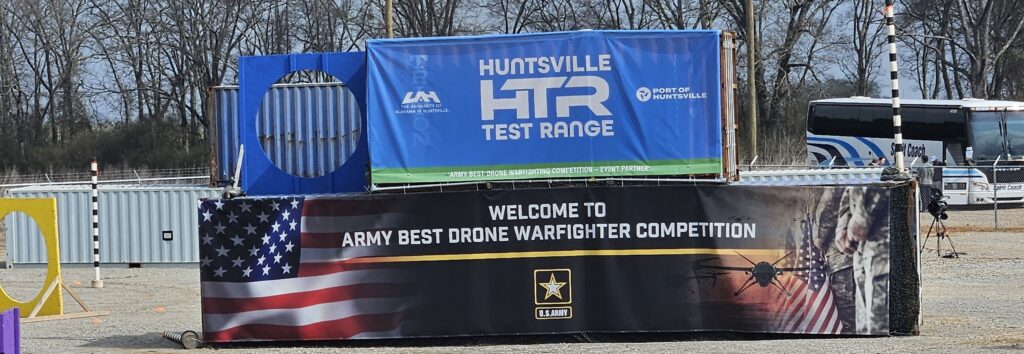
Last week, the Army Aviation Association of America1 hosted the inaugural Army Best Drone Warfighter Competition at the Huntsville UAS and C-UAS Test Range2. Soldiers from across the country competed in a speed course, a tactical challenge, and an innovation challenge. It was also an opportunity to interact with one another, vendors, OEMs, innovation labs, and program offices in workshops, exhibits, and the challenge field.
That level of deep user engagement and collaboration is missing from most military acquisitions. I’ve written previously about the shortcomings of our current requirements-driven acquisition process and how modular, open architectures can help solve the problem by breaking vendor lock and enabling competition. The result is systems that perform better and adapt more quickly to changing mission and user needs.
We’ve seen how critical that is in Ukraine, where drone designers iterate rapidly based on feedback from the field, making systems more effective and producible. Drones have been a key contributor to Ukraine’s resistance against Russian advances, with tactics, counter-tactics, and technology all evolving together. Design cycles for Ukrainian drones are measured in weeks, compared to months or years across NATO countries, and Ukraine has a booming domestic drone industry spurred by government innovation funding and private investment.
With so many different options to choose from and a rapidly-evolving battlefield, Ukraine launched a drone marketplace last year to help Warfighters more quickly get the capabilities that match their needs. Subverting bureaucratic requirement writing, acquisition, allocation, and distribution models by connecting Soldiers directly with the equipment that’s relevant for their mission enables the exact type of transformation the DoD has been trying but failing to achieve, until now.
Amazon for drones
The Army’s Marketplace is scheduled to launch in April as a storefront populated with all of the small, tactical UAS already approved by the Army. It’s modeled on the best e-commerce marketplaces, but calling it “Amazon for drones”3 is selling it short. The storefront is just one component of a broader strategy; the UAS program office is shifting from buying products to curating an ecosystem, which includes:
- New product testing and onboarding — Ensuring that products meet advertised capabilities, are accurately described, and comply with relevant regulations. This ensures trustworthiness in the site and minimizes friction in the user’s product search process.
- Product feedback loops — OEMs see the user reviews on their designs and everyone else’s; rapid feedback helps individual designers and the marketplace as a whole innovate to close operational capability gaps.
- Soldier engagement and continuous communications — Warfighters are passionate experts; tools for collaborating will enable them to share knowledge and lessons learned to get the most out of the UAS ecosystem.
- OEM engagement and continuous communication — The supply side is also a critical component of a rich, sustainable ecosystem.
- Ongoing technology innovation — Technology innovation will be more effective at targeting operational needs regardless of funding source.
For too long, success as a government contractor has depended more on the ability to work the system than the ability to deliver the best product, resulting in mediocre systems delivered over budget and behind schedule.
The Marketplace upends that with a shift to true competition. OEMs that deliver the most value (capability, speed, innovation, price, etc.) will get more business and the underperforming OEMs will fail. The program office plays a critical role in curating this ecosystem and mission alignment will be a competitive differentiator. The result is that taxpayers will get more value and Soldiers will be more effective on the battlefield.
Observations
I talked to everyone I could at the Army Best Drone Warfighter event to get a sense for the UAS landscape. As user researchers are wont to do, I paid particular attention to pain points.
Users were frustrated by a lack of commonality in equipment, especially batteries and battery chargers. Carrying multiple systems for different scenarios means hauling duplicative support equipment, which could be solved by interoperability. Each of the OEMs acknowledged the Army’s stated goals for interoperability, but ultimately don’t have any requirements or incentives to interoperate. Designing for commonality costs money and reduces sales of proprietary ancillary products; with no upside, it hasn’t been a priority for the supplier. I suspect interoperability is inevitable, but it remains to be seen if it will be driven through strong user preference or require a program office mandate.
A few OEMs touted AI capability in some form or another, but AI claims were not as prevalent as I’d expected. In hindsight, that makes sense; edge processing on small vehicles remains limited and it’s not critical for this mission set, where tactical UAS are flown by a single operator in service of the unit’s ground mission. These platforms are essentially militarized versions of racing drones, so C2 solutions are relatively mature and commercially-inspired (contrast with equipment built specifically to military requirements, which may not have close commercial analogues to draw from).
Some of the OEMs expressed concern with investing in developing military-unique capabilities on spec if they might not be selected by users in the marketplace. The government can balance this risk by providing innovation funding and/or minimum order guarantees when necessary to spur new development. Such backstops are mostly appropriate for major new developments; once a competitor is established in the market, they are incentivized to make ongoing improvements to their products to remain competitive.
Future vision
Small UAS is the perfect entry point for the marketplace model: commercial drones are existing commodities, development is rapid, and purchase quantities are large. Once the UAS Marketplace proves the benefits of the approach, it can be expanded to other systems, even tanks and helicopters, by demanding that all new systems be built on open architectures and making approved options available for users to choose from.
What I’m really excited about is the opportunity for open architectures to spur incredible innovations. A developer with a novel idea wouldn’t need to build an entire platform, just a hardware or software module compatible with published and verified interfaces.
This will be especially impactful for autonomous systems. Dozens of independent AI engineers could be working on the same problem sets, taking different approaches to try to train the best solution sets. Proposed solutions can be rapidly iterated and evaluated in simulation based on the latest TTPs observed in the field, with the best solutions quickly pushed out to the front lines.
But I’m getting ahead of myself. The near-term launch of the UAS Marketplace is exciting. If this model works for UAS, it will not remain confined to UAS. It will mark the beginning of a broader disruption in military acquisition.
I’d love to hear from you. If you attended the Best Drone Warfighter Competition, what were your observations? What impacts—positive or negative—do you anticipate the marketplace will have? Are there any drawbacks to increased competition in military system development?