
Artificial Intelligence and Human Judgement: A Cold War Cautionary Tale
Shortly after midnight Moscow time on the 27th1 of September 1983, Stanislav Yevgrafovich Petrov saved the world. This incident, unknown outside of the Soviet air defense forces until 1998, is a highly relevant case study as we accelerate the pace of automation and artificial intelligence in complex military systems.
Cold War backdrop
Cold War tensions between the US/NATO and USSR/Warsaw Pact were higher than they’d been since the Cuban Missile Crisis. Both sides had intermediate-range nuclear missiles on alert, treaty negotiations were breaking down, and NATO was preparing to deploy upgraded Pershing II and additional Ground Launched Cruise Missile systems to counter the Warsaw Pact’s buildup of long-range theatre nuclear forces.
For years the US had been conducting “psychological operations” designed to test defenses, demonstrate nuclear capabilities, and, most importantly, scare Soviet forces. Soviet technology was inferior and the Warsaw Pact Organization was weaker than NATO2. In March 1983, President Reagan called the USSR “the evil empire”. Joint NATO exercises demonstrated strength, often including overflights of Soviet airspace. USSR leaders expected that an attack was forthcoming, putting KGB spies on constant watch for even small signs of the US preparing for imminent action, such as stocking up on blood reserves and readying fallout shelters.
Soviet forces were on a hair-trigger alert. With no defense against nuclear weapons, USSR leaders knew that their only hope was to preempt or retaliate. On the 1st of September 1983, the crew of Korean Air Lines Flight 007, en route from New York to Seoul after refueling in Anchorage, made a navigation error and entered Soviet airspace. Believing it to be a US spy plane, and upset about earlier airspace violations from US exercises in the Pacific, USSR fighter jets were scrambled. It was nighttime so the Soviet pilot could not see the commercial livery, but he did identify the aircraft as a Boeing from the rows of passenger windows, later stating “I did not tell the ground that it was a Boeing-type plane; they did not ask me”. On orders from superiors on the ground, the pilot fired an air-to-air missile at the 747, fatally damaging it. The plane continued to fly for 12 minutes with the pilots having some control for the first few minutes and most likely with all of the passengers alive, until all control was lost and the aircraft eventually broke apart, killing all 269 aboard3.
The end of the world?
As you might imagine, this incident did not help ease the tension in the region. Just a few weeks later, the Soviet Oko (“Eye”) early warning satellite system detected an incoming ICBM, and then a flight of four ICBMs. Lt. Col. Petrov was the duty officer at the Serpukhov-15 control center. His job was to immediately report this threat to higher headquarters; very likely a retaliatory strike would have been ordered in line with Soviet doctrine.
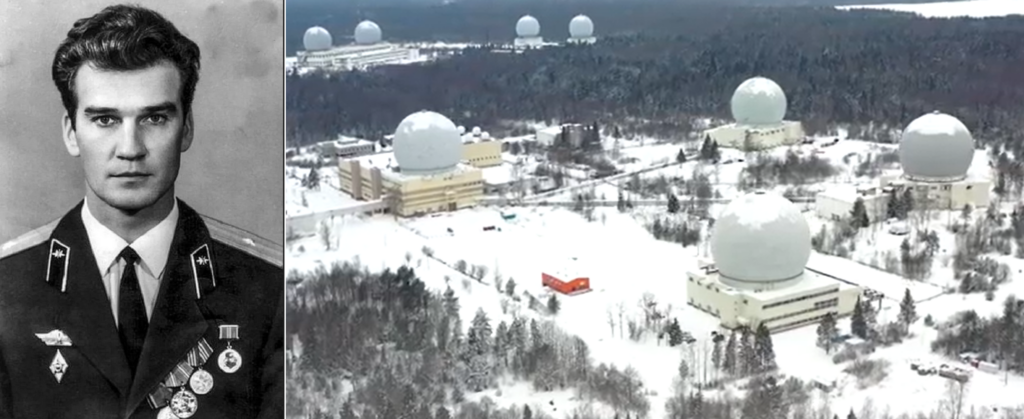
Yet something didn’t feel right to Petrov. For one, a first strike would have been much larger; just five ICBMs was not a logical attack. Also, the system was brand new and not fully validated; as one of the developers of the early warning software, he was an expert in its capabilities and imperfections. Instead of reporting immediately, he waited a few minutes for corroborating detections by ground-based radar, which never came. The end of the story is anticlimactic. He didn’t sound the alarm, no actions were taken, and Petrov logged and reported the incident to improve the system.
Petrov’s actions were privately praised but not officially recognized, as it would have revealed the shortcomings of the missile warning system and put Soviet leadership even further on edge. In an interview years later, after the incident was revealed to the public, Petrov stated that he was intensely questioned, reassigned to a less sensitive post, took an early retirement, and suffered a nervous breakdown. One can imagine the stress he was under, both in the immediate situation and dealing with the Soviet political state in the aftermath.
It was later determined that the false detection was caused by high-altitude clouds over US missile fields strongly reflecting the sun. Oko satellites are in highly-elliptical Molynia orbits which look at the earth from the side, seeing missiles after they are already several miles in the air and against the blackness of space; this has the benefit of a strong signal-to-noise ratio and minimizing false detections from reflections, it just happened that the sun, the Oko satellite, and the clouds lined up in such a way to cause the false detection. PBS Nova has a good write-up with more technical details.
Modern lessons for trust in automation
Had Petrov followed protocol and reported the detection, the Soviets most likely would have launched an attack against the US. That would have prompted an in-kind response from the US and an all-out nuclear war resulting in the deaths of hundreds of millions directly and billions—if not the entire human species—from the resulting nuclear winter.
Petrov notes that his civilian background contributed to his decision, and that someone from a Soviet military background conditioned to only follow orders would not have hesitated to immediately sound the alarm. We saw this with the Korean Air Line incident, where the pilot executed orders as given without caring if the aircraft was of military or civilian nature. This highlights the critical role of the human-in-the-loop: AI may be faster and more analytical, but it only has the data provided to work with, lacking a full context that is especially critical in shifting sociopolitical environments.
Will our future, AI-enabled missile alert systems be as careful as a human? Complex systems can easily become brittle when the situation exceeds the limits of the technology. In these cases, we rely on the human to fill the gap. Yet automation also removes the human from the loop, reducing their situational awareness, technical understanding, and authority to make and execute the right decision. Conversely, systems that effectively combine technology performance and human judgement are resilient and robust.
Human judgement was the difference between a normal September day and Armageddon. Midnight Moscow Summer Time was 2 pm Central Daylight Time in St. Louis, where Bob Forsch would take the mound to pitch a no-hitter against the Montreal Expos. It was 3 pm in Rhode Island where the Royal Perth Yacht Club was successfully challenging the New York Yacht Club’s 132-year defense of the America’s Cup. The day in Moscow would be typically cold and overcast, dreary and unremarkable except that it happened to be the day the USSR would return items recovered from the wreckage of Korean Air Flight 007.
- available sources say the 26th, but I believe they mean the evening of the 26th/morning of the 27th
- curious how we’ve dropped “the” from NATO
- There’s a bit more detail on the enormous Wikipedia entry, including various events that contributed to the Soviet’s determination about the threat, the pilot’s lack of concern about whether the aircraft was civilian or not, the decision to engage even after the plane had departed Soviet airspace, USSR lies and deception in the search and recovery effort, political maneuverings, etc.