
⚠️ Contains spoilers, if you’re the type of person who cares. ⚠️
Netflix’s thriller A House of Dynamite raises important, modern-day questions about our nation’s nuclear deterrence strategy and missile defense capabilities, but it ultimately fell flat for me. With an all-star cast and the Oscar-winning director of The Hurt Locker, it’s still worth a watch for a realistic fictionalized glimpse into the workings of our nation’s ICBM response. Just don’t expect deep insights1.
The Cold War never truly ended
Wikipedia will tell you that the Cold War ended in 1991 as the US-Soviet Union relationship improved, new treaties on nuclear and chemical weapons were signed, and several proxy wars were brought to a close. It certainly began a more peaceful period in world history with serious cooperation between the US and Russia, the fall of socialism and communism, and a wave of democratization and move towards capitalism around the world.
In the intervening decades, both countries have significantly reduced their nuclear arsenals:
Our World In Data: “Nuclear Weapons”
Yet both countries still have around 1,500 nuclear warheads on strategic alert, in missile silos across their respective plains, on submarines, and ready to load on bombers. These form the three legs of the “nuclear triad”: the land leg provides sheer volume and difficulty eliminating, the air leg provides power projection and flexibility in deployment/retargeting, and the undersea leg provides stealth and survivability2. Current nuclear warheads, while limited in power by treaty, are still many times more destructive than those dropped on Hiroshima and Nagasaki3; these arsenals are enough to end the world multiple times over 4.
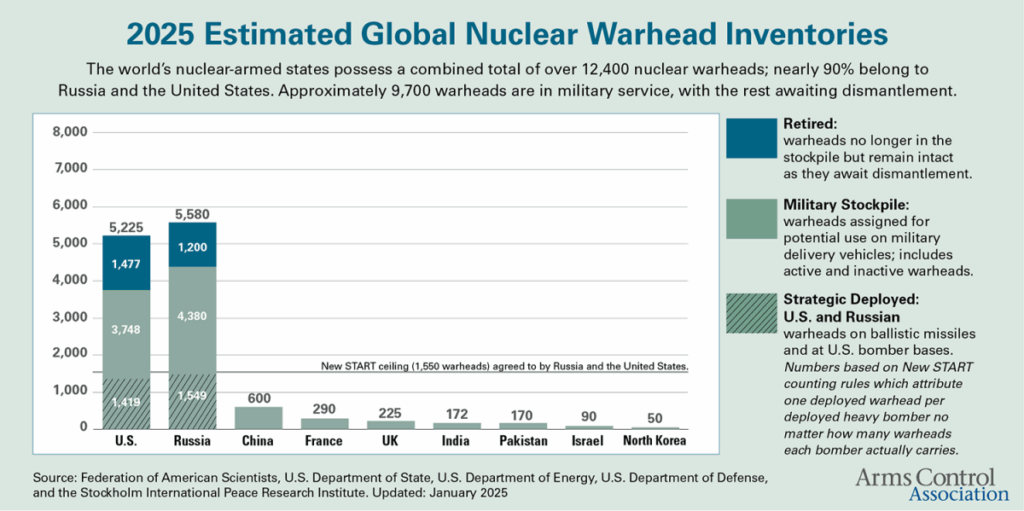
Arms Control Association: “Nuclear Weapons: Who Has What at a Glance”
New threats
The concepts of “nuclear deterrence” and “mutually assured destruction” result in an equilibrium; neither nation dares employ nuclear weapons because they know the response will be proportional. Driven by treaty agreements and deterrence strategy, details of US and Russian nuclear arsenals are surprisingly public. Coordinates for silos and launch control centers are published on Wikipedia 5 and you can buy chunks of the hardened communications cables on eBay.
Yet, many other nations have also acquired nuclear weapons and that certainly makes the calculus more complex, as Tom Lehrer eloquently describes:
The concept of deterrence is predicated on a high degree of certainty that the adversaries have reliable weapons, effective control systems, and resilience to launch a counterattack. None of that can be assumed for countries like North Korea, wildcards with the potential to destabilize global security with little regard for anything other than their own priorities.
To deal with this threat, the US created Ground-Based Midcourse Defense (GMD), which launches interceptors at incoming ICBMs (really, their reentry vehicles during the suborbital phase) in an attempt to destroy them. As the characters in the film point out, it’s like trying to hit a bullet with a bullet and each interceptor is only slightly better than a coin flip; for this reason, multiple interceptors are fired at each threat to increase the odds. The US has 44 interceptors, this capability is meant to defend against the small, rogue states, not a large-scale attack.
The film
A House of Dynamite gestures at this complexity and gets the details right, but fails to come to a meaningful conclusion. In the movie, a single ICBM of unknown origin is detected by the Sea-Based X-Band Radar. The initial launch wasn’t detected by Space-Based Infrared (SBIR) satellites, so the launch location is unknown. No mention is made of determining the type of threat based on signatures. A single ICBM doesn’t match the expected attack profile of any known power. It’s a contrived situation, which is reflected in the bafflement of the characters in the movie as they theorize possible sources, the implications of each, and potential responses. I don’t fault the movie for it, though; an unlikely scenario was perhaps necessary to create an interesting and dramatic story.
In fact, the movie uses a unique narrative device, playing the same few crucial minutes over several times from different perspectives: the White House Situation Room, the Missile Defense Complex at Fort Greely, senior military and government leaders, and the President and First Lady. It’s compelling at first and is used in interesting ways, such as resolving unknowns and apparent inconsistencies while providing additional character development and backstory as the movie unfolds. But about halfway through it started feeling repetitive and a little boring.
Predictably, each major character has someone they’re extremely concerned about in a doomsday scenario: a young child, a pregnant wife, a hopeful fiancée. These exist in the story mainly to add a little bit of dimension to the characters. With one exception6, they don’t drive any meaningful behavior or motivation. I routinely found myself wondering what purpose these family characters served.
In an early vignette, two GMD Ground-Based Interceptors (GBIs) are launched to attempt to destroy the missile; neither succeeded. The portrayal of GMD’s limitations was realistic and could’ve been an interesting angle, but ultimately its contribution to an overall nuclear defense strategy was dismissed as an expensive boondoggle.
With an incoming ICBM of unknown origin, senior military leaders urge the president to authorize a nuclear counterstrike. Against who? It doesn’t matter, only that it’s immediate and decisive or we may all die! This was a major issue in the plot for me. The pressure for a speedy counterstrike seemed entirely artificial when so much was unknown, including, critically, who was responsible. The film tries to manufacture tension by having military advisors insist on immediate retaliation, but their arguments don’t hold up to scrutiny.
In a real scenario like this, the strategic calculus would demand patience, not haste. There was no indication of a larger-scale attack: no additional launch indications, communication jamming, or large-scale force mobilization. The warhead’s size and yield were unknown—it could be a relatively small weapon, a dud, or a hijacked test. Nations around the world shifted to more alert—but not aggressive—postures, exactly the expected response when an unknown actor launches an ICBM at the United States. The single incoming ICBM wasn’t even heading towards any strategically important target7, which might have suggested an attempt at a decapitation strike.
Launching a nuclear counterstrike without knowing the responsible party is strategically incoherent. The entire premise of deterrence theory is that nuclear powers won’t attack because they know retaliation is certain. The threat of retaliation only works as deterrence when it’s directed at the actual aggressor. A panicked, misdirected counterstrike doesn’t restore deterrence; it shatters it by proving the system is unstable and prone to catastrophic miscalculation. A hasty counterstrike risks deteriorating into all-out nuclear war, not preventing our destruction but precipitating it. There’s simply no strategic justification for launching world-ending retaliation against such an ambiguous threat. In fact, doing so seems far more dangerous than the incoming missile itself, with the potential to trigger the exact all-out nuclear exchange that deterrence was designed to prevent.
This false urgency undermines what could have been the film’s most interesting question: In an era of nuclear proliferation beyond the Cold War superpowers, how do traditional deterrence strategies break down? Instead, we get contrived drama that sacrifices strategic realism for manufactured tension. We continually see the countdown to impact while STRATCOM pressures the President to make a retaliatory decision, as if that timer drives the timeline, when it simply does not.
In the minutes before the warhead’s predicted impact, the President struggles with this decision, lamenting that deterrence as a strategy was meant to keep a stable peace and prevent any actual attack. It’s a surface-level discussion at best. The message of the film seems to be “nuclear weapons bad”, underscored by “missile defense technology expensive and useless”, without acknowledgement of the complexities of the world order with unstable regimes in control of nuclear weapons.
Other than the President, there doesn’t seem to be a voice of reason. Throughout the situation, the Secretary of Defense abandons his post and his responsibility to the American people. The stark contrast across SECDEF (cowardly), STRATCOM (gung ho), and the President (cautious) highlights the importance of putting effective, trustworthy individuals into key advisory and decision-making positions. We just start to explore this when the movie ends.
It left me shrugging my shoulders8. I tried to figure out if the movie had a deeper message and decided it didn’t.
Despite these flaws, A House of Dynamite is worth watching. The performances and cinematography are excellent. The technical details are spot-on. Just don’t expect the tight plotting or sharp commentary the premise deserves.
For those who’ve seen it: Am I wrong about the counterstrike urgency being contrived, or did that plot hole bother you too? Was the Secretary of Defense’s abandonment of duty the point, or just bad characterization?
Footnotes:
- Or the biting satire of the original critique of deterrence strategy, Dr. Strangelove
- Deployment of nuclear weapons on surface ships and in space has also been contemplated in the past, even in recent years with the Sea-Launched Cruise Missile-Nuclear program
- To understand the power of these weapons on a human scale, John Hersey’s Hiroshima is well worth a read
- Alex Wellerstein’s NUKEMAP will let you play with various warheads and deployments to compare scales
- You can drive right past them, but I wouldn’t recommend lingering. The Air Force takes nuclear weapon security pretty seriously
- And a silly one at that
- Unless you place undue value on our Strategic Shiny Bean Reserve
- And cursing Netflix for the inexcusably poor captions